10 Must-Have Features for a Successful E-commerce Website in Ghana
3 July 2026 - Francis Agbey

Ghanaian e-commerce is not simply "a shop on the internet." A strong online store has to work with local payment habits, delivery realities, trust concerns, mobile-first browsing, and the way customers move between social media, WhatsApp, and websites before they buy.
That context matters. DataReportal's 2025 Ghana report estimated 24.3 million internet users in Ghana at the start of 2025, with internet penetration at 69.9%. Bank of Ghana's May 2025 payment data also reported 24.2 million active mobile money accounts and 778 million mobile money transactions in April 2025 alone. In other words: the opportunity is real, but customers will only complete purchases when the experience feels fast, familiar, and trustworthy.
Here are the ten features we would prioritise for a serious e-commerce website in Ghana.
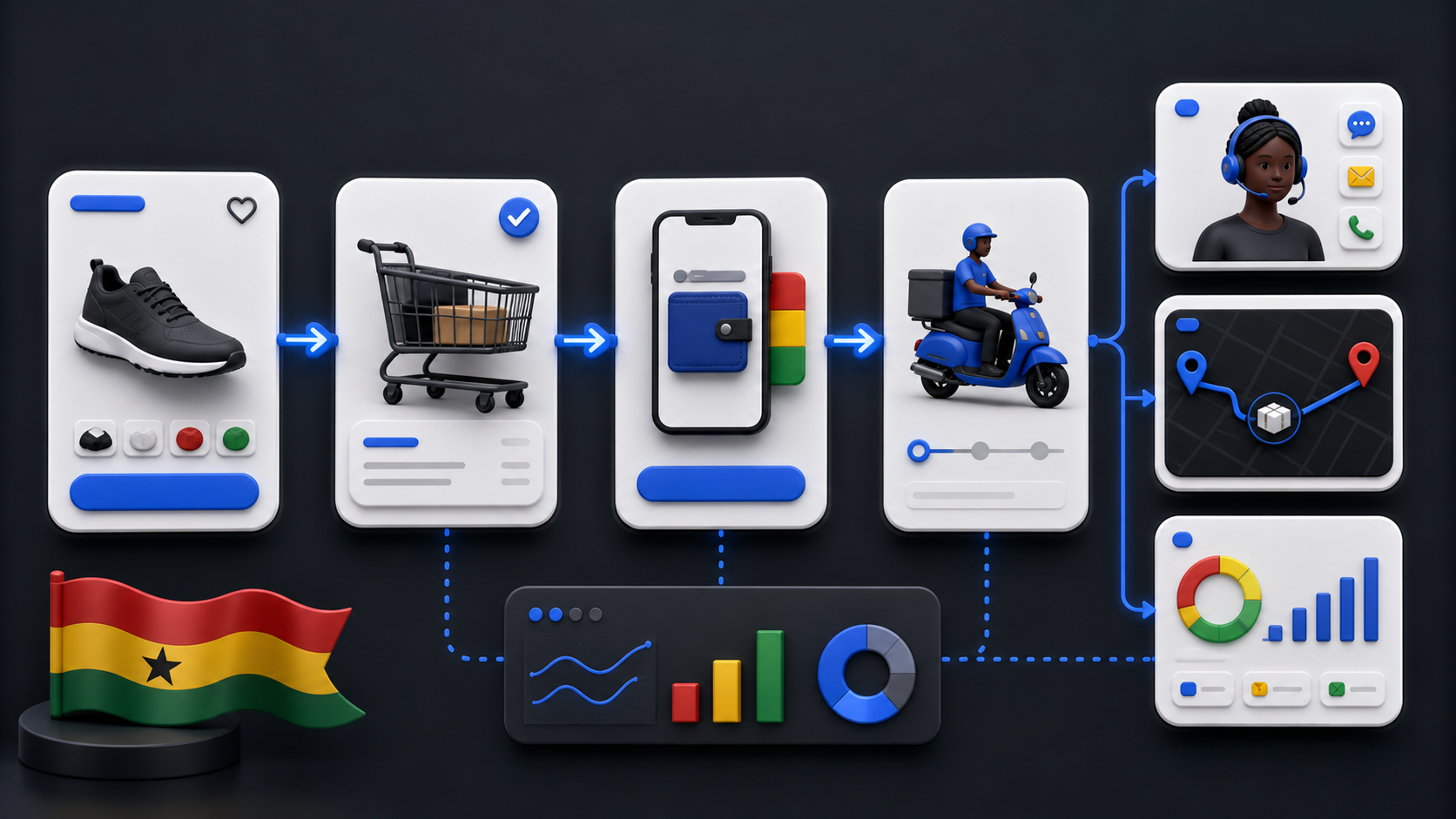
1. Mobile-First Product Discovery
Most customers will encounter your store from a phone: a social post, a WhatsApp link, an ad, a Google result, or a referral. The product discovery experience should therefore be built for small screens before desktop.
That means fast-loading product grids, clear categories, sticky search, simple filters, visible prices, and tap targets that are comfortable on low-cost Android devices. If a customer has to pinch, wait, or scroll through clutter to find the product, they are already drifting back to Instagram or WhatsApp.
For Ghanaian stores, product discovery should also respect how people shop locally:
- Show price, stock status, and delivery availability early.
- Let customers filter by size, colour, brand, location, and price.
- Use real product photos, not only supplier catalogue images.
- Keep product names searchable in the words customers actually use.
The job of the homepage is not to impress the business owner. It is to get a buyer to the right product quickly.
2. Mobile Money and Card Payments
Mobile money support is non-negotiable. A Ghanaian e-commerce checkout should support major mobile money wallets, card payments where appropriate, and a clean payment confirmation flow that does not leave the customer wondering whether the order went through.
Good payment design includes:
- Mobile money number validation before the payment prompt.
- Clear handling for pending, failed, expired, and successful payments.
- Automatic order status updates after provider callbacks.
- A retry path that does not duplicate the order.
- Receipts by email, SMS, or WhatsApp depending on the audience.
Behind the scenes, payments should use idempotency keys so a customer tapping twice does not create two charges. Payment failures should be logged clearly for support teams, because "I paid but my order is still pending" is one of the fastest ways to lose trust.
3. Transparent Delivery Options
Delivery is where many e-commerce experiences in Ghana become messy. A polished storefront can still fail if customers do not know when, where, and how their package will arrive.
At minimum, show delivery options before final payment:
- Same-day or next-day delivery where available.
- Pickup points or branch pickup.
- City, town, or region-based delivery fees.
- Estimated delivery windows.
- Contact details for dispatch follow-up.
If delivery pricing depends on the customer's location, ask for the delivery area early enough to calculate it. Avoid surprising the customer with a delivery fee at the final step. That surprise can kill the order.
4. Trust Signals That Feel Local
Trust is a product feature. It should be designed into the store, not hidden on an "About us" page.
A high-trust e-commerce site should include:
- Real business name, location, and contact channels.
- Return and refund policy written in plain language.
- Verified customer reviews with dates.
- Product warranties where relevant.
- Secure checkout indicators.
- Social proof from actual customers or businesses.
For many buyers, especially first-time customers, the question is not "Do I like this product?" It is "Will this business actually deliver?" Your website should answer that question before the customer asks.
5. Product Pages That Sell and Support
A product page has two jobs: persuade the buyer and reduce support questions. In Ghana, many online stores lose time answering questions that the product page should have handled.
Every serious product page should include:
- Multiple clear images.
- Price and discount information.
- Stock status.
- Size, colour, model, or variant selectors.
- Delivery and pickup options.
- Return eligibility.
- FAQs for common buyer concerns.
- Related products or bundles.
If the product is technical, include specifications. If it is fashion, include sizing guidance. If it is food, beauty, or health-related, include ingredients, usage, and storage details. The more expensive or personal the product is, the more confidence the page must create.
6. WhatsApp and Human Support Integration
Many Ghanaian buyers still want a human touch before they pay. That does not mean your website has failed; it means your website should connect naturally to support.
WhatsApp integration works best when it is contextual. A generic floating button is useful, but a stronger flow passes the product name, SKU, or cart summary into the message so support knows exactly what the customer is asking about.
Useful support features include:
- Product-specific WhatsApp links.
- Order status lookup.
- Support tickets for paid orders.
- Automated confirmation messages.
- Admin notes for support agents.
The goal is not to force every customer into a chat. The goal is to make help available without breaking the purchase flow.
7. Inventory and Order Management
A beautiful site with inaccurate stock is a problem generator. If customers can buy items that are unavailable, your team will spend the day apologising, substituting, and issuing refunds.
Inventory management should include:
- Stock counts per product and variant.
- Low-stock alerts.
- Out-of-stock states that prevent checkout.
- Back-in-stock notifications.
- Admin controls for order fulfilment.
- Audit history for stock changes.
This becomes especially important for businesses selling across multiple channels: website, Instagram, WhatsApp, physical shop, and marketplace listings. The website should not be a separate island. It should be part of the operating system of the business.
8. Fast Performance on Real Networks
Performance is not a luxury feature. It directly affects sales.
An e-commerce website in Ghana should be optimised for mobile networks, older devices, and customers who may not wait through heavy pages. Use compressed images, server-rendered pages where possible, caching, clean JavaScript, and a checkout that does not depend on unnecessary third-party scripts.
Important performance targets:
- Product pages should load quickly on mobile data.
- Images should be responsive and compressed.
- Search and filtering should feel instant.
- Checkout should avoid layout shifts.
- Pages should remain usable when network quality dips.
The fastest website is often the one with the fewest distractions. Every animation, tracking script, popup, and giant image should earn its place.
9. Analytics That Track the Whole Funnel
You cannot improve what you cannot see. E-commerce analytics should go beyond page views and tell you where money is being lost.
Track the full funnel:
- Product views.
- Add-to-cart events.
- Checkout starts.
- Payment attempts.
- Payment failures.
- Successful orders.
- Repeat purchases.
- Best-selling products by margin, not only revenue.
This data should inform practical decisions: which products to promote, where customers abandon checkout, what delivery areas are growing, which payment method fails most often, and which campaigns bring buyers instead of browsers.
10. Admin Tools Built for Daily Operations
The customer-facing store is only half the system. The admin experience determines whether the business can operate smoothly after orders start coming in.
A useful e-commerce admin should let the team:
- Add and edit products quickly.
- Manage categories, prices, variants, and discounts.
- Process orders by status.
- Export sales reports.
- Reconcile payments.
- Assign delivery or pickup fulfilment.
- See customer history.
- Manage refunds and cancellations with proper permissions.
If the admin panel is weak, the website becomes a brochure with a checkout button. A serious store needs operational tooling that supports the real work behind the screen.
What to Build First
If budget or time is limited, do not try to build every advanced feature at once. Start with the features that protect trust and revenue:
| Priority | Feature | Why it matters |
|---|---|---|
| 1 | Mobile-first catalogue | Customers must find products easily |
| 2 | Mobile money checkout | Payment must match local behaviour |
| 3 | Delivery pricing | Customers need total cost before paying |
| 4 | Order notifications | Buyers need confidence after payment |
| 5 | Admin order management | The team needs to fulfil reliably |
After that, layer in advanced analytics, loyalty, abandoned cart recovery, recommendations, subscriptions, marketplace integrations, and deeper automation.
Final Thoughts
A successful e-commerce website in Ghana is not defined by how many features it has. It is defined by how confidently a customer can discover a product, trust the business, pay in a familiar way, and receive the order without confusion.
The best stores feel simple to the customer because the complexity has been handled behind the scenes: payments, delivery, inventory, support, analytics, and admin workflows all working together.
If you are planning an e-commerce platform, treat the website as the front door to a full commerce system. That is how online stores move from "we have a website" to "we have a sales engine."
Sources: DataReportal Digital 2025 Ghana, Bank of Ghana Summary of Economic and Financial Data, May 2025